
Congratulations on Taking the First Step
to More Digital Visibility!
Then next step is to schedule a Strategy session...

Digital marketing in 2026 is more complex than posting on social media or running occasional ads. Small businesses now compete in a marketplace shaped by artificial intelligence, privacy changes, shifting search behavior, short-form video, and customers who expect fast, personalized experiences across every channel.
The good news is that small businesses do not need massive budgets to grow online. They need a focused strategy, clear positioning, consistent execution, and the ability to measure what actually drives revenue.
The digital marketing environment in 2026 rewards businesses that combine strong fundamentals with smart use of new tools. Search engines, social platforms, email platforms, analytics systems, and advertising networks are increasingly powered by AI, which means visibility depends on both technical readiness and the quality of the customer experience.
At the same time, customers are more selective about the brands they trust. They compare options quickly, read reviews, watch videos, ask AI tools for recommendations, and expect consistent information across websites, maps listings, social profiles, and ads.
A focused digital marketing strategy helps small businesses avoid spreading their time and budget across too many channels. Instead of trying to be everywhere, the goal is to identify where the target audience spends time, what problems they need solved, and which marketing activities are most likely to influence a purchase decision.
This focus also makes performance easier to measure. When a business knows its primary goals, such as generating local leads, increasing online sales, improving repeat purchases, or building brand awareness, it can choose the right platforms and track the metrics that matter most.
Trust is one of the most valuable assets in digital marketing. In 2026, customers often encounter a business several times before they contact, visit, or buy from it.
Relevance is equally important. Generic content and broad advertising are less effective when audiences expect personalized answers and specific value. Small businesses can stand out by addressing real customer questions, highlighting local or niche expertise, and creating content that matches each stage of the buying journey.
Before investing heavily in advertising or advanced marketing automation, small businesses need a strong online foundation. Paid campaigns can drive traffic, but if the website is confusing, slow, outdated, or inconsistent with the brand promise, potential customers may leave without taking action.
This foundation starts with accurate business information, clear messaging, a mobile-friendly website, and visible proof of credibility. Small businesses should make it easy for visitors to understand what they offer, who they serve, why they are different, and how to take the next step.
A small business website should be designed around user intent. Visitors usually arrive with a specific need, such as comparing services, checking prices, finding contact details, reading reviews, or deciding whether a business is trustworthy.
Conversion optimization does not always require a complete redesign. Improvements such as faster loading speed, clearer calls to action, stronger headlines, better mobile formatting, and more persuasive proof points can make a significant difference.

For many small businesses, local visibility remains one of the most important digital marketing opportunities. Accurate map listings, complete business profiles, recent customer reviews, and consistent contact information help customers find and trust a business when they are ready to act.
Brand visibility also extends beyond search results. Social media profiles, directory listings, video platforms, and customer review sites all contribute to how people perceive a business.
Content remains one of the most reliable ways for small businesses to earn attention, answer customer questions, and build long-term visibility. In 2026, effective content is less about publishing as much as possible and more about creating useful, trustworthy resources that help people make decisions.
A strong content strategy should connect directly to business goals. A local accountant might create articles about tax deadlines, bookkeeping mistakes, and cash flow planning.
Customers rarely move from first awareness to purchase in one step. They often research symptoms, compare options, evaluate pricing, look for proof, and then decide whether to contact or buy.
Awareness-stage content might explain a problem or introduce a need, such as “signs your roof needs repair” or “how to choose the right CRM for a small business.” Consideration-stage content can compare solutions, answer objections, or explain pricing factors.
Small businesses often feel pressure to publish constantly, but content quality matters more than volume. A single detailed, well-structured guide that answers a high-value customer question can outperform dozens of generic posts.
Businesses should also refresh existing content regularly. Updating old pages with current pricing information, new examples, improved formatting, stronger calls to action, and recent customer insights can improve performance without starting from scratch.
AI tools can help small businesses brainstorm topics, summarize research, outline articles, repurpose content, and speed up production. However, AI should not replace the business’s real expertise, customer knowledge, or brand voice.
The most effective approach is to use AI as an assistant rather than a final author. Business owners and marketers should add original examples, local knowledge, product details, customer stories, and practical recommendations.
Search marketing in 2026 includes traditional search engine optimization, local search, voice search, visual search, and AI-generated answers. Customers may discover a business through search results, map packs, snippets, AI assistants, video results, or review platforms.
The fundamentals still matter. Websites should be technically sound, easy to crawl, fast to load, and structured around clear topics. Pages should use specific language that matches how customers search, while still sounding natural and helpful.

Topical authority means becoming a reliable source around a specific subject area. Instead of writing one broad article about a service, a business can build a cluster of related pages that answer supporting questions.
This approach helps search engines understand the depth of the business’s expertise. It also gives potential customers more useful information, which can increase confidence before they book an appointment or request a quote.
Local search intent is especially powerful because it often indicates that a customer is close to taking action. Searches such as “near me,” “open now,” “best,” “cost,” and “service in my area” show that customers are actively comparing options.
Consistency is critical. A business name, address, phone number, hours, services, and website details should match across major platforms and directories. If customers see conflicting information, they may lose trust or choose a competitor.
AI-powered search tools often summarize information from multiple sources and recommend businesses based on relevance, credibility, and clarity. To improve the chance of being understood and referenced, small businesses should write content that answers questions directly, defines services clearly, and includes specific details about who they serve and what makes them different.
Structured content is helpful. Clear headings, concise explanations, frequently asked questions, comparison sections, and detailed service descriptions make it easier for both users and AI systems to interpret the page.
Paid advertising can help small businesses generate traffic, leads, and sales faster than organic channels alone. However, advertising costs have increased in many industries, and broad campaigns can waste budget quickly.
Small businesses should start with clear campaign goals. A campaign designed to generate phone calls will require different targeting, messaging, and tracking than a campaign designed to sell products online or build awareness for a new brand.
The best advertising platform depends on customer intent and buying behavior. Search ads are useful when people are actively looking for a solution, such as emergency repairs, legal help, software, or medical services.
Small businesses do not need to advertise everywhere at once. A local service company might begin with search ads and map visibility because customers are already looking for help.
Strong ad creative makes the value proposition clear within seconds. Customers should quickly understand what is being offered, why it matters, and what action they should take next.
Small businesses should test multiple versions of headlines, visuals, offers, and calls to action. For example, one ad might focus on affordability, while another focuses on speed, quality, or expertise.
Sending paid traffic to a generic homepage often reduces campaign performance. A landing page should match the ad message and make the next step obvious.

Landing pages should be fast, mobile-friendly, and free from unnecessary distractions. Important information such as benefits, pricing factors, testimonials, service areas, guarantees, and frequently asked questions should be easy to find.
Clicks and impressions are useful, but they do not tell the full story. Small businesses should track leads, purchases, phone calls, booked appointments, form submissions, cost per acquisition, conversion rate, and return on ad spend.
Accurate tracking is especially important as privacy rules and browser restrictions continue to change. Businesses may need to combine platform data, website analytics, customer relationship management data, call tracking, and sales records to understand performance.
Acquiring new customers is important, but retaining existing customers is often more profitable. Email and SMS marketing give small businesses direct ways to communicate with people who have already shown interest.
In 2026, the most effective email and SMS strategies are personalized, permission-based, and useful. Customers are more likely to engage when messages are relevant to their interests, purchase history, location, or stage in the customer journey.
A strong list starts with clear consent. Small businesses can invite people to subscribe through website forms, checkout pages, appointment forms, in-store signage, lead magnets, loyalty programs, webinars, or exclusive offers.
List quality matters more than list size. A smaller group of engaged subscribers is more valuable than a large list of people who ignore every message.
Automation helps small businesses stay consistent without manually sending every message. A welcome sequence can introduce the brand, explain key benefits, share popular resources, and encourage a first purchase or consultation.
Other useful automations include abandoned cart reminders, appointment reminders, renewal notices, birthday offers, reactivation campaigns, and review requests. These messages work best when they feel timely and helpful rather than robotic.
Personalization can increase engagement, but it should be handled carefully. Customers appreciate relevant recommendations and reminders, but they may feel uncomfortable if messages seem intrusive.
Simple personalization can be highly effective. Examples include addressing customers by name, sending service reminders based on past purchases, recommending products in the same category, or sharing location-specific updates.
Social media in 2026 is not just a place to post announcements. It is a discovery engine, a customer service channel, a trust-building tool, and a platform for community engagement.

A strategic social media presence starts with understanding the audience and choosing the platforms that fit the business model. A restaurant, salon, fitness studio, or retail brand may benefit from highly visual platforms and short-form video.
Each social platform has its own style, audience behavior, and content format. Short videos may work well for demonstrations, behind-the-scenes moments, product highlights, and quick tips.
Small businesses should repurpose ideas without copying the same post everywhere. A blog article can become several short videos, a checklist, a quote graphic, a carousel, and an email topic.
Social media works best when businesses participate in conversations rather than simply broadcasting promotions. Responding to comments, answering questions, sharing customer content, highlighting employees, and engaging with local or niche communities can strengthen relationships and increase visibility.
Community-focused content helps humanize the brand. A local bakery might feature customer celebrations, staff favorites, seasonal menu testing, and community events. A software company might share customer success stories, product tips, team insights, and educational discussions.
Follower count is not the only measure of social media success. Small businesses should track engagement quality, website visits, messages, leads, saves, shares, comments, and sales influenced by social activity.
Performance should be reviewed by content type and business objective. If educational posts generate saves and shares, they may be helping with awareness and authority.
Video has become one of the most influential formats in digital marketing because it communicates personality, proof, and value quickly. Short-form video is especially powerful for discovery, while longer videos can support education, product demonstrations, webinars, and customer onboarding.
In 2026, customers often expect to see how a product works, what a service experience looks like, who is behind the business, and what other customers think.
The best video topics come from common customer questions and decision points. A contractor could show before-and-after transformations, explain project timelines, or discuss mistakes to avoid.
Small businesses should also consider videos that reduce friction in the sales process. Pricing explanations, service comparisons, product care guides, and “what to expect” videos can help customers feel more confident before contacting the business.
Consistent video creation does not require a studio. A simple process can include planning a batch of topics, recording several videos at once, editing lightly, and repurposing clips across platforms.

Businesses should focus each video on one idea. A short video might answer a single question, show one product feature, or explain one customer benefit.
One video can support multiple marketing goals. A customer testimonial can become a social post, a website proof point, an email feature, and part of a paid retargeting campaign.
Repurposing helps small businesses get more value from every piece of content. Instead of constantly creating from scratch, they can build a library of useful video assets that support awareness, consideration, conversion, and retention.
Digital marketing does not end when someone clicks an ad, visits a website, or sends a message. Every interaction shapes whether the customer moves forward or leaves.
A strong customer experience connects marketing, sales, and service. If ads promise fast quotes but response times are slow, trust is damaged. If social media promotes premium service but the website is confusing, customers may hesitate.
Small businesses should regularly review the steps customers take before making a purchase or booking a service. Common friction points include unclear pricing, hard-to-find contact information, long forms, slow response times, limited payment options, confusing product pages, and lack of trust signals.
Small improvements can produce meaningful results. Adding online scheduling, simplifying quote forms, offering digital payments, displaying availability, answering common objections, and sending automatic confirmations can make the process easier.
Speed matters. Customers often contact multiple businesses at once, and the first helpful response can win the opportunity. Small businesses should create systems for managing inquiries from website forms, email, phone calls, live chat, text, social messages, and review platforms.
Automation can help with immediate confirmations, routing, and basic answers, but human follow-up remains important for complex questions and relationship building. A fast response should also be accurate, friendly, and aligned with the brand promise.
Customer reviews are both a trust signal and a source of market research. Positive reviews reveal what customers value most, while negative reviews identify gaps in service, communication, or expectations.
Review themes can improve marketing messages. If customers often praise punctuality, friendly staff, quality materials, or clear communication, those strengths should appear on service pages, ads, social posts, and email campaigns.
Need help with Mastering Digital Marketing: Proven Strategies for Small Businesses in 2026?

Local search is changing quickly as artificial intelligence becomes part of how people discover nearby products, services, and trusted providers. Instead of relying only on traditional search results, customers now ask AI assistants, map tools, voice search, and generative search experiences for recommendations that feel immediate, personalized, and context aware.
For local businesses, this shift creates a new opportunity. AI-driven GEO optimization focuses on helping search systems understand where your business operates, who you serve, what makes you relevant, and why you should appear in location based recommendations when nearby customers are ready to act.
Traditional local SEO has long depended on signals such as business listings, reviews, website content, proximity, and relevance. These signals still matter, but AI search systems interpret them in more advanced ways.
This means a customer searching for a nearby service may not type a simple phrase like “plumber near me.” They might ask, “Who can fix a leaking pipe today and has good reviews for emergency work?” AI search tools can evaluate that request across multiple signals, including service descriptions, review language, operating hours, response speed, and geographic service areas.
AI-driven GEO optimization helps local businesses prepare for this more conversational and intent based search environment. It involves making business information accurate, structured, consistent, and rich enough for AI systems to confidently identify your company as a strong match for location specific needs.
Local SEO is often centered on improving rankings in standard search engine results and map packs. GEO optimization, which stands for generative engine optimization, expands that focus to include how AI powered search engines, chat based assistants, and generative answer tools understand and recommend local businesses.
In practical terms, GEO optimization looks beyond ranking for a single keyword. It considers how your business is represented across the digital ecosystem, how clearly your expertise is explained, how customers describe your services in reviews, and whether AI systems can extract reliable information about your location, availability, specialties, and reputation.
AI search systems rely on a broad range of signals to determine whether a local business is relevant, trustworthy, and useful for a user’s request.
Consistency is one of the most important foundations. If your business name, address, phone number, hours, service areas, or category information differ across platforms, AI systems may have less confidence in your data.

Location remains a major factor in local discovery, but AI adds more nuance to how geography is interpreted. A business may be evaluated based on its physical address, service radius, neighborhood references, nearby landmarks, delivery zones, and the language used on location specific pages.
Relevance is also shaped by context. For example, a dental clinic that clearly explains emergency appointments, pediatric services, cosmetic treatments, insurance options, and neighborhood availability gives AI systems more meaningful information to match with different search intents.
AI-driven GEO optimization improves local discoverability by making your business easier for intelligent search systems to interpret, categorize, and recommend. When your website, business profiles, reviews, and local citations all communicate the same clear message, AI tools can form a stronger understanding of your business identity and local relevance.
This is especially important because generative search experiences often summarize options rather than display a long list of results. A user may receive a short answer such as, “Here are three highly rated HVAC companies that offer same day service in your area.” If your business information does not clearly support that recommendation, you may be left out even if you have a strong traditional search presence.
GEO optimization helps close that gap by aligning your digital presence with the way AI evaluates local intent. It gives search systems more complete evidence about what you do, where you do it, who you help, and why customers trust you.
Many AI search queries are longer and more conversational than traditional keyword searches. People ask complete questions, describe specific problems, and expect answers that account for their situation.
To appear in these types of recommendations, your content needs to describe real customer scenarios. A restaurant might mention romantic seating, late evening hours, handmade pasta, reservations, outdoor dining, parking options, and nearby neighborhoods.
This does not mean stuffing pages with every possible phrase. It means writing useful, specific content that mirrors how customers naturally ask for help. AI systems are better able to connect your business to local intent when your content answers practical questions in plain language.

AI systems understand businesses as entities. An entity is a distinct thing with recognizable attributes, such as a business name, location, category, services, staff, reviews, hours, and reputation.
For example, if a local bakery is listed as “Sweet Harbor Bakery” on its website, “Sweet Harbor Bakeshop” on review platforms, and “Harbor Sweets” in directories, AI systems may struggle to connect those references confidently.
Strong entity clarity comes from consistent naming, complete business descriptions, accurate categories, verified profiles, and repeated references to your services and locations. These elements help AI systems understand that all digital mentions point to the same local business.
Location-specific content plays a central role in AI-driven GEO optimization. It helps search systems connect your services with the places where customers are looking. However, effective local content should go beyond simply adding city names to generic pages.
AI search systems look for meaningful context. They evaluate whether your content demonstrates real familiarity with the area, local customer needs, service availability, and location based relevance.
Service area pages can be powerful when they provide useful, specific information. A plumbing company, for instance, could create separate pages for major service areas that describe common local plumbing issues, emergency response availability, nearby neighborhoods, types of properties served, and customer concerns in that location.
A strong service area page might explain that older homes in a particular neighborhood often experience pipe corrosion, while newer developments nearby may need water heater installation or drainage support.
Each service area page should be unique, accurate, and helpful. Duplicating the same content across many city pages with only the city name changed can create weak signals.
Local language helps reinforce geographic relevance when used naturally. Mentioning neighborhoods, landmarks, districts, nearby roads, event areas, or community names can help AI understand your physical or service relationship to a location.

For example, a fitness studio might describe itself as serving members near the arts district, the university area, and surrounding residential neighborhoods. A law firm might mention that it assists clients throughout the county, including specific towns and courthouse locations.
The key is authenticity. Local references should support the user’s understanding, not appear as a list of forced keywords. AI systems are designed to reward helpful context, so location details should make the page more useful and trustworthy.
Your business profiles are among the strongest local data sources for AI systems. Search engines, map platforms, voice assistants, and generative tools often rely on business listings to confirm details such as your address, phone number, hours, categories, services, and customer reviews.
A complete and accurate profile gives AI systems structured information that is easier to interpret than unorganized text alone. It also gives customers the details they need to make quick decisions, especially on mobile devices or voice based searches.
Every major business profile should include complete and current information. This includes your official business name, address, phone number, website, hours, holiday hours, primary category, secondary categories, services, products, amenities, photos, and service areas where applicable.
Small inaccuracies can create confusion. If your website says you close at 6 p.m., but your business profile says 5 p.m., AI tools may hesitate to recommend you for an evening query.
Businesses should review their profiles regularly, especially after changes in hours, phone numbers, staff, services, or locations. For local companies with seasonal offerings, updating profiles before demand changes can help AI systems recognize current availability.
Categories and attributes help AI classify your business. A primary category should describe the core nature of your business as accurately as possible, while secondary categories can support additional services without diluting your identity.
For example, a med spa may need to choose between categories such as medical spa, skin care clinic, laser hair removal service, or wellness center.

Attributes can also influence recommendations. Features such as wheelchair accessibility, outdoor seating, women owned business, emergency service, online appointments, free estimates, delivery, or same day availability can be important when users ask highly specific questions.
Customer reviews are one of the most influential signals in local AI search. They provide direct evidence of customer experience, service quality, reliability, and satisfaction.
This means review content can help search tools understand your strengths. If many customers mention “fast emergency response,” “friendly staff,” “great with children,” “transparent pricing,”or “excellent vegan options,” those phrases can strengthen your relevance for similar local queries.
AI tools can interpret sentiment across reviews to determine whether customers consistently have positive, neutral, or negative experiences. A high star rating is valuable, but detailed comments often provide richer signals.
Service-specific review language is especially useful. A general comment such as “Great company” is helpful, but a review that says “They repaired our AC the same day during a heat wave and explained the cost before starting” gives AI systems clearer context about availability, service type, urgency, and customer trust.
Business responses to reviews can also support GEO optimization when they are genuine and informative. A thoughtful response can reinforce the service performed, the location served, and the customer experience without sounding forced.
For example, a response might say, “Thank you for trusting our team with your water heater replacement in North Raleigh. We are glad we could provide same day service and help restore hot water quickly.” This type of response gives useful context while still focusing on the customer.
Businesses should avoid generic responses to every review. Repetitive replies can appear automated and add little value. Personalized responses show engagement, strengthen trust, and create additional language that AI systems can use to better understand your local services.

Your website remains one of the most important sources of truth for AI-driven local discovery. While business listings provide structured data, your website gives you more room to explain your expertise, services, locations, processes, guarantees, team credentials, and customer experience.
A strong local website should answer the questions customers are likely to ask before choosing a business. These questions often include what services you provide, where you operate, how quickly you respond, what makes your business different, what customers can expect, and how to contact or visit you.
FAQ content is highly useful for AI search because it closely matches conversational queries. Customers often ask AI tools direct questions, and well-written FAQ sections can provide clear answers that search systems can extract and summarize.
A local HVAC company might answer questions such as “Do you offer emergency AC repair on weekends?” or “How quickly can you service homes in Westfield?” A dental office might answer “Do you accept new patients from nearby neighborhoods?” or “Can I schedule a same day appointment for tooth pain?”
Answers should be concise but complete. They should include relevant service and location details where appropriate, without overloading the content with repetitive keywords. The goal is to make each answer genuinely useful for a real customer.
Service pages should clearly describe what each service includes, who it is for, common problems it solves, and where it is available. Vague descriptions make it harder for AI systems to connect your business to specific customer needs.
For example, instead of only saying “We offer auto repair,” a repair shop could explain brake inspections, oil changes, transmission diagnostics, engine repair, tire replacement, and pre-purchase inspections.
Detailed service content supports both customer confidence and AI understanding. When your pages cover specific use cases, AI tools have more evidence to match your business with detailed local search prompts.
Need help with How AI-Driven GEO Optimization Can Boost Your Local Business Presence?

Business websites are no longer static digital brochures. They are becoming intelligent platforms that can understand visitor behavior, personalize experiences, automate support, and help companies make better decisions based on real-time data.
As artificial intelligence and machine learning become more accessible, website development is shifting toward smarter, more adaptive systems. For businesses, this change is not just about adopting new technology. It is about creating websites that can learn, respond, and improve over time.
Modern users expect websites to be fast, relevant, and easy to navigate. They want product recommendations that make sense, search results that understand intent, and support options that are available when they need help. AI and machine learning make these experiences possible by analyzing patterns and responding to user needs with greater accuracy.
For businesses, intelligent websites can improve more than user satisfaction. They can help increase conversions, reduce operational workload, and reveal valuable insights about customer behavior. Instead of relying only on manual updates or broad assumptions, companies can use AI-powered systems to adapt content, offers, and interactions based on data.
Traditional websites often present the same content to every visitor, regardless of their goals, location, browsing history, or stage in the buying journey. While this approach can still work for basic informational sites, it limits the ability to deliver highly relevant experiences.
Adaptive websites use AI and machine learning to adjust elements such as product suggestions, page layouts, content recommendations, and on-site messages. This creates a more personalized journey that can help visitors find what they need faster and feel more understood by the brand.
AI is influencing nearly every part of website development, from planning and design to testing and optimization. Developers and business owners can now use intelligent tools to streamline workflows, identify technical issues, and create more user-focused digital experiences.

One of the most important changes is the move from reactive decision-making to predictive improvement. Instead of waiting for performance problems or conversion drops to become obvious, AI-powered systems can detect patterns early and suggest adjustments before they affect business results.
Personalization is one of the clearest examples of how AI can improve a business website. By analyzing user behavior, machine learning models can identify what different visitors are likely to need and then present content, products, or services that match those interests.
This can include personalized homepage sections, dynamic product recommendations, customized search results, and tailored content suggestions. When implemented thoughtfully, personalization can reduce friction and make the website feel more helpful without making the experience feel intrusive.
Search is often one of the most important features on a business website, especially for ecommerce stores, service directories, knowledge bases, and content-heavy platforms. Traditional search tools rely heavily on exact keyword matches, which can lead to poor results when visitors use different wording or do not know the exact name of what they need.
AI-powered search can understand intent, context, synonyms, and natural language queries. For example, a visitor searching for “comfortable shoes for standing all day” may receive better results than they would from a basic search engine that only matches the individual words in the query. This type of intelligent search helps users find relevant products, services, or information faster.
Machine learning can also improve navigation by identifying common user paths and highlighting the pages or categories visitors are most likely to need. Over time, this can influence menu structure, internal search suggestions, filters, and recommended next steps across the website.
AI chatbots have become one of the most visible ways businesses use artificial intelligence on their websites. Modern chatbots can answer common questions, guide users through decision-making, collect lead information, recommend products, and route complex issues to human support teams.

For businesses, this can reduce the workload on customer service staff while giving visitors immediate help at any time of day. A well-designed chatbot can assist with appointment scheduling, order tracking, pricing questions, troubleshooting, and service comparisons.
The most effective chatbot experiences are not limited to scripted answers. By using natural language processing, conversational systems can interpret user intent and respond in a more flexible way. However, businesses should still make it easy for users to reach a real person when a question is too complex, sensitive, or specific for automation.
Machine learning can help businesses understand which visitors are most likely to convert, which pages create friction, and which marketing campaigns attract the most valuable traffic. Instead of only reviewing past performance, predictive analytics can estimate future behavior based on patterns in user data.
For example, an AI system may identify that visitors who view a pricing page, read a case study, and return within seven days are more likely to request a quote. With this insight, the website can present a more relevant message, offer a consultation prompt, or prioritize those leads in a customer relationship management system.
AI can also support conversion rate optimization by testing page variations and learning which headlines, layouts, forms, or calls to action perform best for different audience segments. This allows businesses to move beyond one-size-fits-all optimization and toward more precise improvements based on visitor behavior.
Website performance has a direct impact on user experience, search visibility, and conversion rates. Slow pages, broken features, and confusing layouts can cause visitors to leave before they take action. AI and machine learning can help developers monitor, diagnose, and improve performance more efficiently.
Intelligent monitoring tools can detect unusual traffic patterns, identify pages with rising bounce rates, and flag technical issues before they become widespread problems. This gives development teams a clearer understanding of where to focus their attention and how to prioritize improvements.

Testing is an essential part of website development, but manual testing can be time-consuming and easy to overlook as websites grow more complex. AI-assisted testing tools can scan pages, detect visual inconsistencies, identify broken elements, and simulate user interactions across devices and browsers.
For example, an AI testing system may notice that a checkout button is hidden on certain mobile screen sizes or that a form field behaves differently after a recent update. These automated checks can help teams catch issues earlier and reduce the risk of launching broken experiences.
Machine learning can also help prioritize bugs based on severity and user impact. If an issue affects a high-traffic page or a critical conversion path, the system can flag it as more urgent than a minor issue on a rarely visited page.
AI can support faster websites by analyzing performance data and recommending improvements. This may include identifying oversized images, inefficient scripts, slow server responses, or page elements that delay rendering.
In more advanced implementations, AI systems can help predict traffic spikes and adjust hosting resources accordingly. This is especially valuable for ecommerce businesses during seasonal sales, product launches, or marketing campaigns where sudden increases in traffic can strain infrastructure.
Machine learning can also improve content delivery by predicting which assets a user is likely to need next and preparing them in advance. When used carefully, this can create smoother browsing experiences without wasting resources.

Content remains one of the most important parts of a business website. AI can help teams plan, create, organize, and refine content so it better serves both users and business goals. While human strategy and editorial judgment are still essential, AI can make content workflows more efficient and data-informed.
AI can recommend relevant blog posts, guides, products, case studies, or service pages based on visitor behavior. For example, a visitor reading several articles about small business cybersecurity may be shown a related service page, a downloadable checklist, or a comparison guide.
Dynamic messaging can also adjust based on user segment or behavior. A first-time visitor might see educational content, while a returning visitor who has already viewed pricing may see a message focused on scheduling a demo or speaking with sales.
AI writing tools can help businesses draft page copy, generate content outlines, summarize complex topics, create product descriptions, and adapt messaging for different audiences. These tools can be especially useful for speeding up early drafts and maintaining consistency across large websites.
However, AI-generated content should be reviewed carefully for accuracy, tone, originality, and brand alignment. The best results usually come from combining AI efficiency with human expertise.
Machine learning can analyze existing website content to identify outdated pages, duplicate topics, weak-performing assets, and missing content opportunities. This helps businesses decide what to update, consolidate, expand, or remove.
For example, a service business may discover that visitors frequently search for pricing, timelines, or comparison information that is not clearly addressed on the website.

AI-powered websites depend on data, but businesses must collect and use that data responsibly. Visitors are increasingly aware of privacy concerns, and regulations continue to shape how companies handle personal information.
Businesses should be transparent about what data they collect, why they collect it, and how it is used. Personalization should improve the user experience without feeling invasive or manipulative.
Personalized experiences can be helpful when they make navigation easier or recommendations more relevant. However, they can feel uncomfortable if visitors believe they are being tracked too closely or targeted unfairly.
A practical approach is to focus on value-driven personalization. For example, recommending related resources based on the page a visitor is currently viewing is generally less intrusive than using sensitive personal data to influence pricing or access.
Machine learning systems can reflect bias if they are trained on incomplete, inaccurate, or unbalanced data. This can affect search results, recommendations, lead scoring, accessibility decisions, and customer support responses.
Reducing bias requires ongoing monitoring, diverse data inputs, human oversight, and clear rules for how automated decisions are made. AI should support better experiences for users, not create hidden barriers or reinforce unfair assumptions.
Need help with The Future of Business Websites: Integrating AI and Machine Learning?

In website design, a call to action is more than a button or short line of persuasive copy. It is the point where user interest becomes measurable action, whether that action is a purchase, form submission, demo request, download, booking, or newsletter signup. Even strong offers can underperform when the call to action appears in the wrong place, competes with too many distractions, or arrives before visitors understand the value of taking the next step.
Strategic call-to-action placement helps guide visitors through a page in a way that feels natural, helpful, and aligned with their intent. By understanding user behavior, visual hierarchy, page structure, and decision-making psychology, designers can create layouts that make conversion opportunities easier to notice and more compelling to act on.
Visitors rarely read a web page from top to bottom with equal attention. They scan headings, look for visual cues, compare options, and pause only when something feels relevant to their goal. Because of this, CTA placement should be based on how users move through a page, not simply where a button looks visually balanced. A well-placed CTA meets the visitor at a moment when they have enough context to feel confident taking action.
Above-the-fold placement can be useful when the visitor already understands the offer or has arrived with strong intent, such as on a product page, pricing page, or landing page from a targeted ad. However, placing a CTA too early can create friction if the user has not yet learned what makes the offer valuable. In those cases, the first visible CTA should often be supported by a clear value proposition, concise benefit statement, trust signal, or visual that clarifies what the user will receive.
Mid-page CTAs are especially effective when they follow persuasive content, such as a list of benefits, feature explanations, use cases, or social proof. At this stage, the visitor has begun forming an opinion and may be ready to take a low-friction next step. For longer pages, repeating CTAs at logical intervals prevents users from having to scroll back upward once they are ready to convert.

End-of-page CTAs serve a different but equally important role. They capture users who need to review all available information before making a decision. These visitors are often more deliberate, so the final CTA should feel like a natural next step after the content has answered objections, established credibility, and explained the outcome of taking action.
Effective CTA placement depends heavily on the purpose of the page. A homepage usually serves multiple audiences, so its CTAs should help users self-select their path. For example, primary actions might guide high-intent visitors toward a quote request or consultation, while secondary actions might direct research-focused visitors toward services, case studies, or product details. The goal is not to force every visitor into the same action, but to make the next best step easy to identify.
Service pages and product pages should place CTAs near moments of decision. This often means positioning them after benefit-driven sections, comparison points, feature breakdowns, testimonials, or pricing information. When visitors encounter proof that a solution fits their needs, a nearby CTA reduces friction and gives them an immediate path forward.
Blog posts and educational content require a more subtle approach. Readers often arrive looking for information rather than an immediate sales interaction, so aggressive CTA placement can feel disruptive. Instead, CTAs within educational pages should align with the topic and reader intent. A relevant download, consultation offer, newsletter signup, or related resource can perform well when placed after a useful explanation or practical insight.

Landing pages typically benefit from a more focused CTA strategy because they are built around one campaign goal. In this context, placement should reinforce a single conversion path throughout the page. The primary CTA can appear near the hero section, after key benefits, near trust-building elements, and again after objection-handling content. Each placement should support the same action so users are not distracted by competing choices.
Strategic placement works best when it is supported by a strong visual hierarchy. A CTA may technically be in the right location, but if it blends into the surrounding design, users may overlook it. Size, color, spacing, contrast, typography, and surrounding elements all influence whether the CTA feels prominent or secondary. The button or action area should stand out enough to attract attention without appearing disconnected from the rest of the page.
Contrast is one of the most important design tools for CTA visibility. A button color should be distinct from the background and from nearby design elements, especially if the page uses a restrained visual palette. However, contrast does not always mean choosing the brightest color possible. A CTA should feel intentional and brand-aligned while remaining easy to identify. If every badge, icon, banner, and link uses the same high-contrast treatment, the CTA loses its priority.
Whitespace also plays a major role. Crowded CTAs often feel stressful or easy to miss because the eye has no clear resting point. Placing adequate space around a button or form helps frame it as an important action. This is especially valuable near complex sections such as pricing tables, comparison charts, or feature grids, where users may need a clear visual anchor after processing information.
Directional cues can also support CTA placement. These cues might include product images facing toward the button, text alignment that naturally leads the eye downward, or section layouts that guide scanning from headline to supporting copy to action. The best directional cues feel subtle and useful rather than manipulative. They help users understand the page flow instead of forcing attention unnaturally.

One of the most overlooked aspects of CTA placement is timing. Users become ready to act at different points depending on how familiar they are with the brand, how urgent their problem is, and how complex the decision feels. A repeat customer may respond to an early CTA, while a first-time visitor may need education, reassurance, and proof before taking the next step.
For simple offers, such as downloading a checklist or joining a newsletter, a CTA can often appear earlier because the perceived risk is low. For higher-commitment actions, such as purchasing expensive software, scheduling a consultation, or requesting a custom proposal, the CTA should usually appear after the page has addressed value, fit, credibility, and expected outcomes. The more effort, money, or trust required, the more carefully the page must prepare the visitor.
This does not mean high-commitment CTAs should be hidden until the bottom of the page. Instead, they should be layered strategically. An early CTA can serve visitors who already know what they want, while later CTAs can support those who need more information. The copy around each placement can also change slightly based on the user’s stage of readiness. An early CTA might be direct and concise, while a later CTA can reference the benefits or proof already presented.
Designers should also consider micro-commitments. Sometimes the best placement strategy is not to ask for the final conversion immediately, but to offer a smaller step first. For example, instead of asking every visitor to buy now, a website might invite users to compare plans, view a demo, calculate savings, or answer a few qualifying questions. These smaller actions can reduce hesitation and create a smoother path toward the primary conversion.
Mobile design introduces placement challenges that are easy to underestimate. On smaller screens, users scroll quickly, interact with thumbs, and experience content in a more linear format. A CTA that works beautifully on desktop may be too far down the page, too close to other tap targets, or difficult to notice on mobile. Responsive design should not simply shrink the desktop layout. It should rethink CTA visibility and usability for mobile behavior.

Thumb-friendly placement is essential. Buttons should be large enough to tap comfortably and spaced far enough from nearby links or controls to prevent accidental clicks. Mobile users are often multitasking or browsing in short sessions, so the path to action should feel immediate and effortless. If a CTA requires pinching, zooming, excessive scrolling, or repeated backtracking, conversions will likely suffer.
Sticky CTAs can be useful on mobile when used thoughtfully. A persistent bottom button for booking, purchasing, or requesting information can keep the action available as users move through the page. However, sticky elements should not cover important content, create visual clutter, or make the experience feel cramped. They work best when the primary action is clear and the user has enough context to understand it.
Mobile forms deserve special attention because they are often the final step after a CTA click. Placement should lead naturally into a form that feels manageable on a small screen. Short forms, clear labels, appropriate input types, and visible progress cues can prevent abandonment. Even the strongest CTA placement will underperform if the next interaction feels tedious or confusing.
One common mistake is placing too many CTAs too close together. When users are asked to start a trial, book a call, download a guide, watch a video, subscribe, and contact sales all within the same visual area, decision fatigue increases. Multiple actions can be useful, but they need hierarchy.

Another frequent issue is treating every page section as an opportunity to repeat the same button without considering context. Repetition can improve conversions, but only when it feels purposeful.
Designers also sometimes bury CTAs beneath large decorative elements, oversized imagery, or long blocks of text. Visual storytelling can strengthen a page, but it should not interrupt the conversion path.
Finally, vague button copy can weaken even excellent placement. A button that says “Submit” or “Click Here” does not reinforce value or clarify what happens next.
No placement strategy should be treated as permanent without performance data. User behavior varies by audience, traffic source, industry, offer, and device type. Analytics can reveal whether visitors are reaching key sections, where they are dropping off, and which CTAs are receiving engagement. Heatmaps, scroll depth reports, click tracking, form analytics, and conversion funnels can all provide valuable clues about whether placement
Need help with Maximizing Conversions with Strategic Call-to-Action Placement in Website Design?

SEO measurement in 2026 is no longer about watching a single keyword climb or celebrating a temporary traffic spike. Search results are more personalized, AI-generated answers influence discovery, and users often interact with brands across multiple touchpoints before converting. To understand whether SEO is working, teams need to evaluate visibility, engagement, revenue impact, and long-term brand demand together.
A strong measurement framework helps separate meaningful growth from vanity metrics. Instead of asking only whether organic traffic increased, modern SEO reporting should answer whether the right audience is finding the site, whether that audience is taking valuable actions, and whether technical, content, and authority-building efforts are improving business outcomes over time.
The most effective SEO reporting begins with the business objective, not the analytics dashboard. A SaaS company may care most about qualified demo requests, while an ecommerce brand may prioritize non-branded organic revenue, repeat purchases, and category page performance. A publisher might focus on organic sessions, returning visitors, ad revenue, and topical authority. The right SEO metrics depend on what success actually means for the organization.
Before building a reporting template, define the role SEO is expected to play in the customer journey. Some pages are designed to attract early-stage searchers, some support product comparisons, and others are built to convert visitors who are already close to buying. Measuring every page with the same standard can lead to misleading conclusions. An informational guide may be successful if it earns visibility, engages readers, and assists later conversions, even if it does not generate immediate sales.
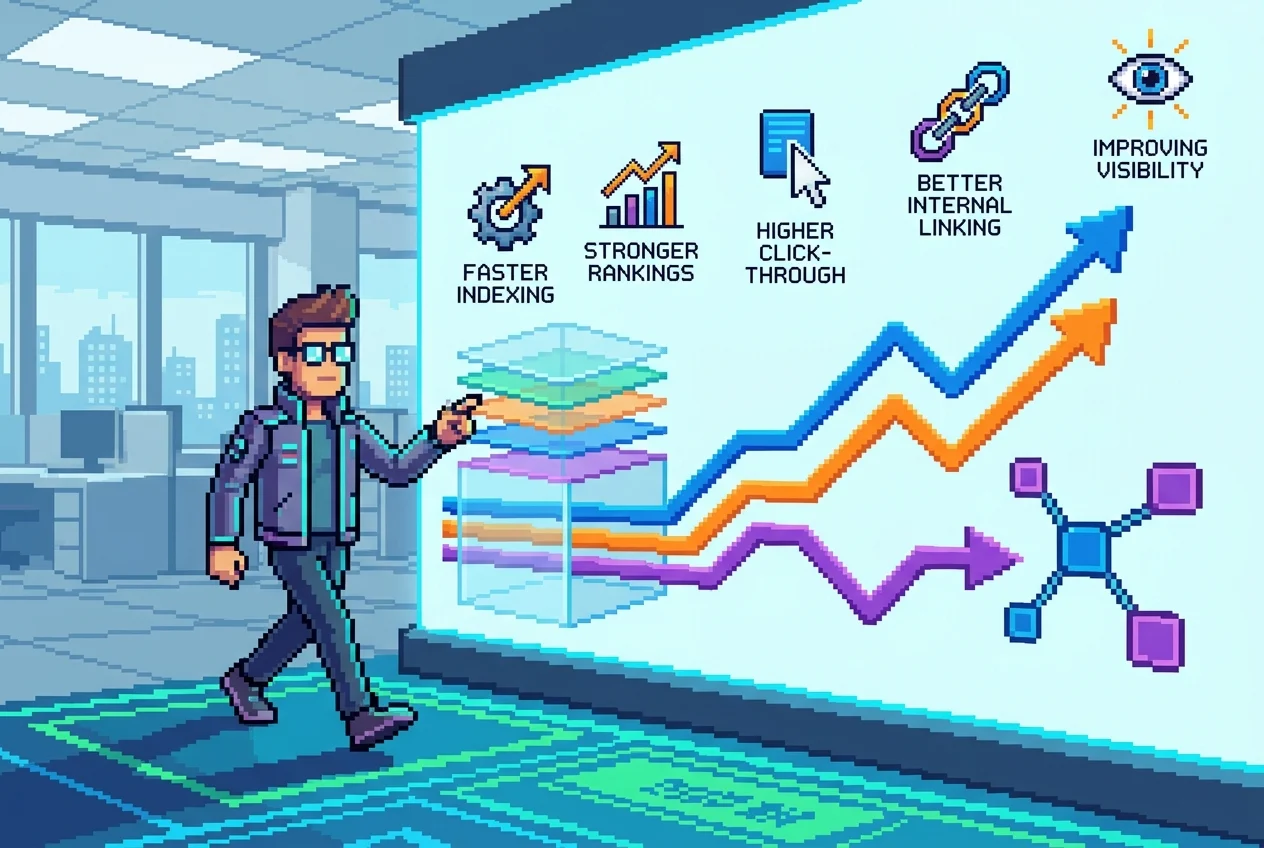
Leading indicators show whether SEO work is moving in the right direction before revenue results fully appear. Examples include improved crawlability, faster indexing, stronger rankings for priority topics, higher click-through rates, better internal linking, and growth in impressions for relevant queries. These signals help teams understand whether their strategy is gaining traction.
Outcome metrics show the business impact of that progress. These include conversions, pipeline, revenue, customer acquisition cost, assisted conversions, and retention-related actions influenced by organic search. In 2026, the strongest SEO reporting combines both types of measurement, because leadership needs to see business value while practitioners need diagnostic signals that guide the next round of optimization.
AI-powered search experiences and rich search results can reduce the number of clicks available for certain queries, even when visibility is strong. This makes it important to measure more than raw traffic. Impressions, brand searches, referral quality, engagement depth, and conversion rate can reveal whether SEO is creating demand and trust even when the user journey does not begin with a traditional blue-link click.
For many brands, a decline in clicks for basic informational queries may not indicate SEO failure. It may reflect a shift in how search engines answer simple questions directly. The key is to identify which queries still drive valuable visits, which topics build authority, and which search experiences influence brand awareness. SEO success in 2026 requires interpreting visibility within the context of changing search behavior.
A useful SEO dashboard should balance visibility, traffic quality, technical health, engagement, and commercial impact. Tracking too many numbers can make reporting confusing, while tracking too few can hide important performance issues. The goal is to choose a focused set of metrics that explain what is happening, why it is happening, and what should be improved next.
These metrics should also be segmented wherever possible. Branded and non-branded search performance should be reviewed separately, as should informational and transactional pages. Mobile and desktop behavior may differ significantly, and international sites often need country-level reporting. Segmentation turns generic SEO data into actionable insight.
Organic visibility measures how often a site appears in search results for relevant queries. Key indicators include total impressions, keyword ranking distribution, share of voice, visibility for topic clusters, and the number of pages receiving impressions. These metrics help show whether search engines increasingly recognize the site as a relevant source within its market.
Search demand should also be monitored through branded search volume and query growth around priority products, services, or topics. Rising branded searches can indicate that SEO, content, public relations, social media, and offline marketing are working together to increase awareness. When branded demand grows alongside non-branded visibility, it often signals stronger overall market presence.

Organic sessions are still important, but traffic volume alone is not enough. A high-quality visitor is one who matches the intended audience and takes meaningful steps after landing on the site. Metrics such as engaged sessions, average engagement time, pages per session, scroll depth, return visits, and landing page relevance can help determine whether SEO is attracting the right people.
It is also important to compare traffic quality across page types. Blog posts, product pages, category pages, help center articles, and comparison pages naturally behave differently. A technical tutorial may have a long reading time but few direct conversions, while a pricing page may have fewer visits but a much higher conversion rate. Evaluating each page according to
its purpose creates a more accurate picture of performance. A landing page designed for purchase intent should be judged by conversion efficiency, while an educational article should be judged by qualified discovery, content engagement, assisted conversions, and its contribution to topical authority.
Organic conversions are among the most important SEO success metrics because they connect visibility to business outcomes. These conversions may include purchases, form submissions, demo bookings, phone calls, account signups, newsletter subscriptions, quote requests, or downloads. The correct conversion event depends on the business model and the stage of the buyer journey.
Revenue measurement should go beyond last-click attribution whenever possible. Organic search frequently introduces users to a brand early, then assists conversions through later visits from direct, paid, email, or retargeting channels. Assisted conversion data helps reveal the hidden value of SEO content that influences decisions without receiving final-click credit. For B2B companies, connecting organic landing pages to qualified leads, opportunities, and closed deals can make SEO reporting far more meaningful to executives.
Keyword rankings remain useful, but they should not be treated as the only measure of SEO success. Search results are now highly dynamic, with personalization, location, device type, SERP features, AI summaries, shopping modules, video results, and local packs affecting what users see.

Instead of tracking thousands of keywords without context, group keywords by intent, funnel stage, topic, product line, and business priority. Monitor how many important terms are in positions 1 to 3, 4 to 10, 11 to 20, and beyond page two.
Technical SEO measurement shows whether search engines can efficiently discover, crawl, render, index, and understand your content. Even the strongest content strategy can underperform if pages are blocked, slow, duplicated, poorly linked, or difficult to render.
User experience is closely connected to technical performance because search engines want to surface pages that satisfy users. A page that loads quickly, displays properly on mobile devices, avoids intrusive elements, and provides a clear path to useful information is more likely to retain visitors and support conversions.
Important technical metrics include indexed page count, excluded page patterns, crawl errors, redirect chains, canonicalization issues, duplicate content, broken internal links, orphan pages, sitemap accuracy, and robots.txt problems.
Index coverage should be reviewed by template or section. For example, if key product pages are excluded while thin tag pages are indexed, the site may be sending mixed quality signals.

Core Web Vitals remain useful performance indicators, especially when they are measured with real user data. Metrics such as Largest Contentful Paint, Interaction to Next Paint, and Cumulative Layout Shift help teams understand how quickly pages load, how responsive they feel, and whether the layout remains stable.
However, performance scores should be interpreted alongside business data. A page with average technical scores but strong conversion performance may need a different optimization approach than a slow page with high traffic and poor engagement.
Content measurement in 2026 should focus on whether a site is becoming a trusted resource for its most important topics. Publishing more articles is not automatically a sign of progress.
Topical authority can be evaluated through ranking breadth, internal link strength, content freshness, query diversity, and performance across clusters of related pages. If a group of articles, guides, product pages, and comparison resources collectively gains impressions and conversions, that cluster may be strengthening the entire site’s relevance for a topic.
Review performance at both the individual page level and the cluster level. Individual page metrics include impressions, clicks, engagement time, conversions, scroll behavior, backlinks, and ranking keywords.
For example, a cybersecurity company might track a cluster around phishing prevention. Success would not depend on one article alone. It could include improved rankings for glossary terms, stronger engagement on educational guides, more internal clicks to product pages, and increased demo requests from visitors who first entered through informational content.

Content decay occurs when rankings, clicks, or conversions decline over time because information becomes outdated, competitors improve their pages, or search intent changes. Measuring decay helps teams protect existing traffic instead of focusing only on new content creation.
Refresh candidates can be identified by looking for pages that once performed well but now show reduced clicks, lower click-through rate, fewer ranking keywords, outdated examples, or weak engagement.
No single tool provides a complete view of SEO success. Search engines, analytics platforms, rank trackers, crawlers, log analyzers, heatmap tools, and customer relationship management systems each reveal a different part of the story.
Google Search Console remains essential for measuring impressions, clicks, average position, indexing issues, page experience signals, and query-level performance. Analytics platforms such as Google Analytics 4 help evaluate user behavior, traffic sources, events, conversions, and revenue.
For deeper insight, teams may use log file analyzers to understand crawler behavior, business intelligence dashboards to combine data sources, and CRM systems to connect organic visits with leads, pipeline, and sales. Ecommerce businesses should also connect
Need help with How to Measure SEO Success: Key Metrics and Tools for 2026?